Tuesday, August 24, 2010

Julius Caesar

Characters:

  • Brutus 
    • supporter of republic who believes strongly in a government guided by the votes of senators
    • kills Caesar out of belief of its benefit to Rome
  • Julius Caesar
    • Roman general and senator
  • Antony
    • friend of Caesar
    • claims allegiance to Brutus and conspirators of Caesar after Caesar's death in order to save his own life
    • however persuades audience at Caesar's funeral to condemn Brutus as a traitor
  • Cassius
    • acquaintance of Caesar
    • dislikes how Caesar has become godlike in the eyes of the Romans
    • convinces Brutus to kill Caesar
  • Octavius
    • Caesar's adopted son and appointed successor
    • joins with Antony to fight Cassius and Brutus
  • Casca
    • public figure opposed to Caesar's power
  • Calpurnia
    • Caesar's wife
    • believes in omens and portents
  • Portia
    • Brutus's wife
  • Flavius
    • a tribune (official elected by people to protect their rights)
  • Cicero
    • Roman senator renowned for oratorical skill
    • speaks at Caesar's victory parade
    • dies at the order of Antony, Octavius and Lepidus
  • Lepidus
    • third member of Antony and Octavius's coalition
  • Murellus
    • tribune who condemns plebeians for their fickleness
  • Decius
    • member of the conspiracy
    • convinces Caesar that Calpurnia has misinterpreted her nightmares

Plot summary:
  • Flavius and Murellus find Roman citizens neglecting their work to watch Caesar's victory parade.
  • A soothsayer calls out to Caesar to "beware the ides of March" but Caesar ignores him.
  • Brutus confesses to Cassius that he fears Caesar will become a king at the will of the people. Cassius blames him and himself for allowing Caesar's rise to power, given that once Caesar was so physically weak. 
  • Caesar tells Antony that he deeply distrusts Cassius
  • Casca tells Brutus and Cassius that during the celebration, Caesar refused Antony's three offers for the crown of Rome. Even though Caesar had a seizure and fell to the ground the Roman populace nonetheless cheered him on.
  • Cassius hatches a plot to draw Brutus into a conspiracy against Caesar.
  • Brutus finds letters in his house from citizens apparently concerned about Caesar becoming too powerful. The letters were actually forged and planted by Cassius.
  • Cassius arrives at Brutus's home and Brutus agrees to a plan to lure Caesar from his house and kill him. Brutus refuses to kill Antony as well.
  • Calpurnia pleads with Caesar not to go to the senate - she describes a nightmare she had in which a statue of Caesar was streaming with blood and smiling men bathed their hands in the blood. Although Calpurnia finally convinces him to stay at home, Decius arrives and convinces Caesar that his wife has misinterpreted her dreams. Caesar leaves for the Senate.
  • The soothsayer tries to warn Caesar again but fails to get his attention. A citizen, Artemidorus, hands Caesar a letter warning him about the conspirators but Caesar refuses to read it. 
  • At the Senate, the conspirators encircle Caesar and one by one, stab him to death. When Caesar sees Brutus amongst the murderers, he gives up struggling and dies. The murderers bathe their hand and swords in Caesar's blood. 
  • Antony returns and pledges allegiance to Brutus but weeps over Caesar's body. He then asks for permission to speak at Caesar's funeral. Brutus grants him permission even though Cassius remains suspicious of Antony. When the conspirators leave, Antony swears to avenge Caesar's death.
  • Brutus and Cassius speak to the public at the Forum and explain that they murdered Caesar to prevent him from being a danger to Roman liberty. 
  • Brutus then turns the pulpit over to Antony who reminds the crowd how Caesar brought wealth and glory to Rome. He then describes Caesar's death and shows Caesar's wounded body to the crowd. He also reads Caesar's will which left money to every citizen and ordered his gardens to be made public.
  • The public becomes enraged at Brutus and Cassius and set off to drive them from the city.
  • Octavius arrives in Rome and forms a coalition with Antony and Lepidus. They prepare to fight Cassius and Brutus, who are raising an army in exile.
  • At their camp, Brutus and Cassius argue about money and honor, and Brutus reveals that he is grieving for the death of Portia, who killed herself. That night, the Ghost of Caesar appears to Brutus and announces that he will meet him again on the battlefield.
  • On the day of the battle, Octavius ignores Antony's advice on where to attack, thus asserting his power as Caesar's heir.
  • Cassius sees his men fleeing and sends Pindarus to see how matters are progressing. Pindarus sees Titinius, Cassius's best friend, surrounded by cheering troops and concludes that Titinius has been captured. Cassius despairs and orders Pindarus to kill him. Titinius then arrives - the cheering men were actually his comrades. Titinius sees Cassius's corpse and kills himself.
  • Brutus learns of the deaths of Cassius and Titinius. When his army loses, Brutus impales himself on his own sword. 
  • Octavius and Antony arrive, and Antony says Brutus was the nobles Roman of all, as he genuinely acted for the benefit of Rome. Octavius orders Brutus be given an honorable funeral.

Monday, August 23, 2010

Macbeth

Characters:
  • Macbeth
    • Scottish general and thane of Glamis
    • led to wicked thoughts by prophecies of the three witches
    • unable to bear psychological consequences of his atrocities
  • Lady Macbeth
    • deeply ambitious woman who lusts for power and position
    • urges husband to kill Duncan and seize the crown
    • falls victim to guilt and madness
    • eventually commits suicide
  • The Three Witches
    • they plot mischief against Macbeth using charms, spells and prophecies
    • their predictions prompt Macbeth to murder Duncan, to order the deaths of Banquo and his son, and to blindly believe in his own immortality
  • Banquo
    • noble general whose children, according to the witches' prophecy, will inherit the Scottish throne
    • his ghost haunts Macbeth
  • King Duncan
    • King of Scotland whom Macbeth murders for the throne
  • Macduff
    • Scottish nobleman who becomes leader of rebellion against Macbeth
    • the rebellion is to place the rightful king, Malcolm, on the throne, but Macduff also wants revenge for Macbeth's murder of Macduff's wife and son
  • Malcolm
    • son of Duncan
    • becomes King of Scotland with Macduff's aid
  • Hecate
    • goddess of witchcraft who helps the three witches work their mischief on Macbeth
  • Fleance
    • Banquo's son who survives Macbeth's attempt to murder him
  • Lennox and Ross
    • Scottish noblemen
  • The Murderers
    • group of ruffians hired by Macbeth to murder Banquo, Fleance and Macduff's family
  • Porter
    • drunken doorman of Macbeth's castle
  • Lady Macduff
    • Macduff's wife
  • Donalbain
    • Duncan's son, Malcolm's younger brother

Plot summary:
  • Play begins with brief appearance of trio of witches on a Scottish moor who make plans to confront Macbeth.
  • At a military camp, King Duncan receives news that his generals Macbeth and Banquo have successfully quashed rebellions. Duncan declares that Macbeth be given the title of the thane of Cawdor, who was defeated.
  • Macbeth and Banquo meet the three witches on the way to Duncan's court. The witches hail Macbeth as thane of Glamis (his original title) and Cawdor, which surprises him because he has not yet heard of Duncan's decision. The witches also predict that Macbeth will become king. They also tell Banquo that he will not be king, but that his children will sit upon the throne.
  • Ross and Angus arrive to take Banquo and Macbeth to the king. Ross tells Macbeth that he has been made thane of Cawdor. Macbeth is amazed at the witches' prophecy and wonders if he will indeed become king.
  • At court, Duncan announces Malcolm, his son, as the successor to his throne. Macbeth realizes that Malcolm now prevents the fulfilment of the witches' prophecy. 
  • The king decides to dine at Macbeth's castle. 
  • Macbeth sends a letter to his wife telling her about his promotion and his meeting with the witches. She decides to do whatever it takes to get the crown. 
  • Macbeth arrives ahead of the king and Lady Macbeth persuades him to kill the king that very night.
  • They get Duncan's chamberlains drunk until they pass out and do not remember anything in order to blame the murder on them. While Duncan is asleep, Macbeth stabs him despite his doubts and supernatural omens. 
  • When Duncan's death is discovered te next morning, Macbeth kills the chamberlains and assumes the kingship. Duncan's sons Malcolm and Donalbain flee to England and Ireland out of fear for their lives.
  • Fearful of the witches' prophecy that Banquo's heirs will seize the throne, Macbeth hires murderers to kill Banquo and his son Fleance. Although they kill Banquo, they fail to kill Fleance. 
  • At a feast that night, Banquo's ghost visits Macbeth, which causes him to start raving in front of other Scottish noblemen, who begin to dissent at his kingship.
  • Macbeth visits the witches in their cavern and they predict that he must beware of Macduff, a Scottish nobleman who opposed Macbeth's accession to the throne. They also predict that Macbeth will be incapable of being harmed by any man born of a woman, and that he will be safe until Birnam Wood comes to Dunsinane Castle. 
  • Macbeth is relieved, but nonetheless orders Macduff's castle to be seized and his family murdered when he learns that Macduff has fled to England to join Malcolm.
  • The news of his family's execution reaches Macduff in England and he joins Malcolm's army which he has raised in England against Macbeth. 
  • Lady Macbeth, in the meantime, begins sleepwalking and believes bloodstains are on her hands. She kills herself before the invasion arrives.
  • Macbeth becomes depressed at the news of his wife's suicide. Nonetheless he fortifies Dunsinane, where he awaits Malcolm's invasion. However, he becomes increasingly worried when he learns that Malcolm's army is advancing on Dunsinane shielded with boughs cut from Birnam Wood.
  • On the battlefield, Macbeth comes face to face with Macduff who declares that he was "untimely ripped" from his mother's womb. Macduff beheads Macbeth and Malcolm ascends the throne.

Sunday, August 22, 2010

Love's Labour's Lost

Characters:

  • Ferdinand, King of Navarre
    • referred to only as "King"
    • scholar who has sworn an oath to uphold his scholarship at the expense of earthly pleasures, especially receiving women at his court
  • Berowne, Longaville, Dumaine
    • lords who join the King in his oath of scholarship
    • they fall in love with Rosaline, Maria and Katherine, respectively
  • Princess of France
    • visits King of Navarre and plays a game of wit with the King and his lords
  • Rosaline, Maria, Katherine
    • three ladies attending the Princess
  • Boyet
    • lord attending the Princess
    • serves as messenger to the king's court and exchanges jokes with the lords
  • Don Armado
    • Spaniard who falls in love with Jaquenetta
  • Mote
    • Don Armado's page
  • Costard
    • the fool
    • accidentally switches Armado and Berowne's letters
  • Jaquenetta
    • country wench caught with Costard by Don Armado
  • Sir Nathaniel, Holofernes
    • curate and schoolmaster, respectively
    • provide learned commentary on the letters of other characters
    • responsible for masque of Nine Worthies near the end of the play
  • Dull
    • constable usually appearing with Sir Nathaniel and Holofernes
  • Mercade
    • lord attending on Princess

Plot summary:
  • The King of Navarre and his 3 lords, Berowne, Longaville and Dumaine, swear an oath to scholarship, which includes fasting and avoiding contact with women for 3 years
  • They receive a letter from Don Armado telling them he has caught Costard and Jaquenetta consorting in the park
  • The King announces Costard's sentence and they go off to begin their oath.
  • Don Armado confesses to Moth that he has fallen in love with Jaquenetta. 
  • He writes her a letter which he asks Costard to deliver.
  • The Princess of France arrives to visit the King but the King cannot receive her because of his oath. He visits them at their camp outside the castle.
  • The King and his lords fall in love with the Princess and her ladies.
  • Berowne gives Costard a letter to deliver to Rosaline but Costard accidentally switches it with the letter from Don Armado to Jaquenetta.
  • Jaquenetta brings Berowne's letter to Holofernes and Sir Nathaniel to read for her but they tell her it was meant for someone else. They deliver it instead to the King.
  • Berowne watches the King as he reads about his love for the Princess. 
  • Longaville enters. The King hides, and both Berowne and the King observe Longaville reading about his love for Maria.
  • Dumaine enters, and Longaville hides. Longaville, the King and Berowne observes Dumaine reading an ode he wrote to Katherine.
  • Longaville enters and tells Dumaine that he is in love as well.
  • The King enters and scolds both for breaking their oath.
  • Berowne enters and reveals that the King is in love as well.
  • Jaquenetta arrives and gives Berowne the letter, which he rips up. However, Dumaine picks a piece of the letter up with Berowne's name on it and Berowne confesses that he is in love as well.
  • The four men decide to court their women and they go to the Princess's pavilion dressed as Muscovites.
  • The women switch favors so that the men mistake them for each other. 
  • After the men reappear as themselves, the women reveal their prank, and they all watch a show of the Nine Worthies performed by Don Armado, Sir Nathaniel and Holofernes. 
  • A messenger arrives with the news that her father has died, and the women return to France telling their men to seek them again in a year.

King Lear

Characters:

  • King Lear
    • aging king of Britain
    • used to enjoying absolute power and to being flattered
    • prioritizes the appearance of love over actual devotion
  • Cordelia
    • Lear's youngest daughter
    • disowned for refusing to flatter him
    • married by King of France for her virtue despite her lack of dowry
    • remains loyal to Lear despite his cruelty and forgives her
    • also displays forbearing temperament towards Goneril and Regan
  • Goneril
    • Lear's ruthless oldest daughter
    • wife of duke of Albany
    • jealous, treacherous, amoral
    • challenges Lear's authority
    • initiates affair with Edmund
    • wrests military power from her husband
  • Regan
    • Lear's middle daughter
    • wife of duke of Cornwall
    • as ruthless as Goneril
    • jealously competes for Edmund with Goneril
  • Gloucester
    • nobleman loyal to King Lear
    • father of bastard son, Edmund
    • like Lear, he misjudges which of his children to trust
  • Edgar
    • Gloucester's older, legitimate son
  • Edmund
    • Gloucester's younger, illegitimate son
    • resents bastard status and schemes to usurp Gloucester's title and possessions from Edgar
  • Kent/ Caius
    • loyal to King Lear
    • spends most of play disguised as peasant Caius so he can continue to serve Lear even after his banishment
  • Albany
    • husband of Goneril
    • good at heart and eventually denounces cruelty of Goneril, Regan and Cornwall
  • Cornwall
    • husband of Regan
    • domineering, cruel and violent
    • works with wife and Goneril to persecute Lear and Gloucester
  • Fool
    • Lear's jester who uses double-talk and seemingly frivolous songs to advise Lear
  • Oswald
    • steward of Goneril's household who helps her in her conspiracies

Plot summary:
  • King Lear decides to step down from throne of Britain and wants to divide his kingdom evenly among his 3 daughters
  • To test them, he asks each of them how much she loves him. Goneril and Regan give their father flattering answers, but Cordelia remains silent, saying she has no words to describe how much she loves her father. Lear gets angry and disowns Cordelia.
  • The king of France marries Cordelia even without her land and she accompanies him to France.
  • Goneril and Regan begin to undermine Lear's authority and Lear begins to go insane.
  • He flees his daughters' houses and wanders on a heath during a great thunderstorm accompanied by his Fool and Kent in disguise.
  • The Earl of Gloucester is tricked by Edmund into believing that Edgar is out to kill him. 
  • Edgar disguises himself as a crazy beggar, "Poor Tom", in order to avoid the manhunt his father has set on him. He heads out onto the heath as well.
  • Gloucester decides to help King Lear. Regan and Cornwall accuse him of treason, blind him, and turn him out to wander the countryside. Edgar in disguise leads him to Dover, where Lear has also been brought.
  • In Dover, a French army lands as part of an invasion led by Cordelia to save her father. 
  • Edmund becomes romantically entangled with Regan and Goneril.
  • Goneril and Edmund conspire to kill Albany, who is becoming increasingly symapthetic to Lear's cause.
  • Gloucester tries to commit suicide but Edgar saves him by leading him off an imaginary cliff.
  • The English troops, led by Edmund, reach Dover and defeat the French led by Cordelia.
  • Cordelia and Lear are captured.
  • Edgar duels and kills Edmund. Gloucester dies. Goneril poisons Regan out of jealousy over Edmund and then kills herself when her treachery is revealed to Albany. Cordelia is executed in prison and Lear dies of grief at Cordelia's death. Albany, Edgar and the elderly Kent remain.

Henry IV (part 2)

Characters:

  • King Henry IV
    • dies before end of play, never fulfilling dream of leading Crusades in Jerusalem
  • Prince Hal/ Harry
    • son of King Henry, eventually becomes Henry V
  • Prince John, Duke of Lancaster; Humphrey, Duke of Gloucester; Thomas, Duke of Clarence
    • sons of King Henry IV, younger brothers of Prince Hal
  • The Lord Chief Justice
    • most powerful official of law in England
    • close advisor to King Henry IV
    • becomes advisor and father figure for Prince Hal after Henry IV's death
  • Earl of Warwick, Earl of Surrey, Earl of Westmoreland, Gower, Harcourt, Sir John Blunt
    • Noblemen who are King Henry IV's advisors
  • Sir John Falstaff
    • pretends to have killed Hotspur at the Battle of Shrewsbury, and for this reason everyone respects Falstaff more than he deserves
  • Page
    • carries Falstaff's sword and runs his errands
  • Poins, Peto, Bardolph
    • former highwaymen and robbers who have gained money and prestige since the Battle of Shrewsbury
    • Bardolph is an insatiable drinker with a bright red nose
  • Ancient Pistol
    • ensign who serves under Falstaff and is extremely aggressive and prone to fighting
  • Mouldy, Shadow, Wart, Feeble and Bullcalf
    • army recruits Falstaff inspects in Gloucestershire
    • only Shadow, Wart and Feeble come with him to war; the others bribe their way out
  • Archbishop of York
    • powerful northern clergyman who leads rebellion against King Henry IV
  • Mowbray and Hastings
    • lord who conspire with Archbishop of York
  • Lord Bardolph
    • ally of Northumberland who brings him false news of Hotspur's sucess
  • Doll Tearsheet
    • Falstaff's favorite prostitute
  • Fang and Snare
    • incompetent officers of law whom Mistress Quickly calls to arrest Falstaff
  • Justice Shallow and Justice Silence
    • middle-class country landowners
    • also minor local law officers
    • Shallow is old school friend of Falstaff's
    • both live up their names
Plot summary
  • King Henry has recently become ill
  • Falstaff is now an army captain traveling around the countryside recruiting young men
  • Prince Hal spends less time with his criminal friends
  • The rebel leaders gather forces against the king at the Forest of Gaultree
  • The Earl of Northumberland refuses to offer aid 
  • Prince John, the king's second son, leads the king's army to meet them, and agrees to meet their demands. However, as soon as the rebel leaders send their soldiers home, he arrests and executes them for treason.
  • King Henry becomes increasingly ill. Prince Hal comes to court and vows that he will be a responsible king. King Henry forgives him and dies. Prince Hal, now King Henry V, begins to view the Lord Chief Justice as a father figure.
  • After the execution of the rebels, Hal is formally crowned King Henry V. When Falstaff and his lowly friends greet him in the street, he rejects them and tells them they must never come within 10 miles of the king or court again. He nonetheless offers them a pension. The young king then goes to court to plan an invasion of France. 

Henry IV (part 1)

Characters:

  • King Henry IV
    • feels guilty about having won his throne through civil war against Richard II
    • worries about civil war
    • vexed by irresponsible eldest son, Prince Harry
  • Prince Harry/ Prince of Wales/ Hal/ Harry Monmouth
    • will eventually become Henry V
    • spends time hanging around highwaymen, robbers and whores, but eventually reveals noble qualities
  • Hotspur/ Henry Percy
    • son and heir of Earl of Northumberland, nephew of Earl of Worcester
    • nicknamed Hotspur from fierceness in battle and hastiness of action
    • becomes archrival of Prince Harry
  • Sir John Falstaff
    • Prince Harry's closest friend 
    • fat old man who makes his living as a thief, highwayman and mooch
    • instructs Prince Harry in the ways of vagabonds and criminals
  • Earl of Westmoreland
    • nobleman who is close companion and ally of King Henry IV
  • Lord John of Lancaster
    • younger son of King Henry and younger brother of Prince Harry
  • Sir Walter Blunt
    • ally of King 
  • Thomas Percy, Earl of Worcester
    • Hotspur's uncle
    • mastermind behind Percy rebellion
  • Henry Percy, Earl of Northumberland
    • Hotspur's father
    • conspires to rebel but does not actually bring his troops to the Battle of Shrewsbury
  • Edmund Mortimer, Earl of March
    • Owain Glyndwr's son-in-law
    • conflation of both the historical figures of Mortimer and the Earl of March
    • has claim to the throne before King Henry overthrew Richard II
  • Owain Glyndwr
    • leader of Welsh rebels
    • joins Percys in rebellion
    • mysterious and superstitious and sometimes acts according to prophecies and omens
  • Archibald, Earl of Douglas
    • leader of Scottish rebels in Percy rebellion
    • usually called "The Douglas", traditional title for Scottish clan chief
  • Sir Richard Vernon
    • relative and ally of Earl of Worcester
  • Archbishop of York a.k.a. Richard Scrope
    • has grievance against King Henry and thus is on the side of the Percys
  • Ned Poins, Bardolph and Peto
    • criminals and highwaymen
    • friends of Falstaff and Prince Harry who go with them to war
  • Gadshill
    • another highwayman
  • Mistress Quickly
    • hostess of Boar's Head Tavern where Falstaff and friends go to drink

Plot summary:
  • Henry IV has 2 main plots - first, the strained relationship between King Henry IV and his son, Prince Harry; and second, the rebellion plotted by the Percys who are angry because King Henry refuses to acknowledge his debt to them
  • The play opens with the news that the Welsh rebel Glyndwr has defeated King Henry's army in the South and Hotspur is refusing to send soldiers to the king whom he has captured in the North
  • Meanwhile, Prince Harry, King Henry's son, is drinking in a bar with criminals and highwaymen. Harry claims that this is actually part of a plan to impress the public when he eventually changes his ways.
  • Poins arrives at the bar and announces his plans to rob a group of wealthy travellers. Harry initially refuses to participate but Poins explains to him that he is actually playing a practical joke on Falstaff.
  • Hostpur arrives at court and reveals that his family is displeased with the king as they had helped Henry overthrow Richard II without receiving favors in return. Hotspur's family members explain their plan to build an alliance to overthrow the king.
  • Harry and Poins successfully carry out their plan to dupe Falstaff. In the middle of this a messenger summons Harry back to court with news of civil war brewing.
  • The alliance which the Percys have formed with other nobles and rebels from Scotland and Wales begins to falter, which necessitate them going to war at once.
  • Harry returns to court and is chided by his father. He decides to prove himself by vanquishing Hotspur in battle and accompanies his father to the battlefront.
  • At The Battle of Shrewsbury, Harry saves his father's life in battle and wins back his father's approval. Harry also defeats Hotspur in single combat. Most of the Percy family are put to death.
  • However, powerful rebel forces remain in Britain and King Henry sends his sons to deal with them. Henry IV II begins where this play finishes.

Thursday, August 19, 2010

Hamlet

x
To read or not to read....when there's a great adaptation by Kenneth Branagh (Gilderoy Lockhart!).

Characters:

  • Hamlet
    • Prince of Denmark
    • son of Queen Gertrude and late King Hamlet
    • nephew of Claudius
    • melancholy, bitter, cynical, hates his uncle's scheming and is disgusted at his mother
  • Claudius
    • King of Denmark
    • Hamlet's uncle
    • calculating, ambitious politician
  • Gertrude
    • Queen of Denmark
    • Hamlet's mother
    • marries Claudius after death of King Hamlet
  • Polonius
    • Lord Chamberlain of Claudius's court
    • father of Laertes and Ophelia
  • Horatio
    • Hamelt's close friend
  • Ophelia
    • daughter of Polonius
    • was once Hamlet's lover
    • obeys father and brother
    • gives in to Polonius's schemes to spy on Hamlet
    • goes mad and eventually drowns in the river
  • Laertes
    • Polonius's son and Ophelia's brother
    • dies in duel with Hamlet
  • Fortinbras
    • young prince of Norway whose father was killed by Hamlet's father
    • seeks revenge through attacking Denmark
  • The Ghost
    • specter of Hamlet's deceased father
  • Rosencrantz and Guildenstern
    • courtiers and former friends of Hamlet from Wittenberg
    • summoned by Claudius to discover the cause of Hamlet's strange behavior
  • Osric
    • foolish courtier who summons Hamlet to duel with Laertes (played by Robin Williams!)
  • Marcellus and Bernardo
    • officers who first see the ghost walking Elsinore and summon Horatio to witness it

Plot summary:

Sparknotes has a video for the plot summary.

  • Marcello and Bernardo ask Horatio to see the ghost who has been walking on the ramparts of Elsinore Castle.
  • Horatio brings Hamlet to see the ghost, which resembles his father. The ghost speaks to Hamlet and tells him that he was murdered by Claudius, his brother and Hamlet's uncle who has recently married his mother. The ghost instructs Hamlet to seek revenge.
  • Hamlet becomes melancholy and even appears mad while plotting his revenge. This makes Claudius and Gertrude worry about him and they employ Rosencrantz and Guildenstern to watch him.
  • Polonius suggest that Hamlet may be lovesick for Ophelia and Claudius spies on a conversation between Hamlet and Ophelia. Hamlet, however, merely orders Ophelia into a nunnery and declares that he wants to ban marriages.
  • Hamlet tests his uncle's guilt by staging a play with a group of traveling actors. The play's plot resembles that of how Claudius killed Hamlet. Claudius leaves the room when the play reaches the murder scene.
  • Hamlet seeks out Claudius to kill him but Claudius is praying. Thinking that killing him while praying will send him to heaven, Hamlet stays his hand and waits. Claudius orders Hamlet to go to England.
  • Hamlet confronts his mother. He accidentally kills Polonius who was hiding behind a tapestry because he believed it was the king. Hamlet is immediately dispatched to England with Rosencrantz and Guildenstern, who hold orders for the King of England to put Hamlet to death.
  • Ophelia goes mad with grief and drowns herself. Polonius's son, Laertes, returns to Denmark from France and Claudius convinces him that it is all Hamlet's fault.
  • Hamlet returns to Denmark after pirates attack his ship en route to ENgland.
  • Claudius plots to kill Hamlet by secretly poisoning a sword Laertes will use in a supposedly friendly fencing match with Hamlet. He also decides to poison a goblet which he will give Hamlet to drink if Hamlet seems to be winning.
  • Hamlet returns to Elsinore just as Ophelia's funeral is taking place. 
  • Osric arrives on Claudius's orders to arrange the fencing match between Hamlet and Laertes. 
  • Hamlet scores the first hit but doesn't drink from the king's goblet. Instead, Gertrude drinks and is killed by the poison. Laertes wounds Hamlet and Hamlet wounds Laertes. Before dying, Laertes tells Hamlet that Claudius tried to poison him. Hamlet stabs Claudius with the poisoned sword and forces Claudius to drink the poisoned wine. They both die.
  • At that moment, Fortinbras arrives and sees the entire royal family dead. Horatio, fulfilling Hamlet's last request, tells him the entire story, and Fortinbras orders that Hamlet be buried in a manner befitting his position. 

The Comedy of Errors

x
Characters

  • Antipholus of Syracuse 
    • twin brother of Antipholus of Ephesus
    • son of Egeon
    • traveling with slave, Dromio of Syracuse, to find his long-lost brother and mother
  • Antipohlus of Ephesus
    • twin brother of Antipholus of Syracuse
    • son of Egeon
    • well-respected merchant in Ephesus
    • Adriana's husband
  • Dromio of Syracuse
    • slave of Antipholus of Syracuse
    • twin brother of Dromio of Ephesus
  • Dromio of Ephesus
    • slave of Antipholus of Epheseus
    • twin brother of Dromio of Syracuse
  • Adriana
    • wife of Antipholus of Syracuse
    • fierce, jealous woman
  • Luciana
    • Adriana's unmarried sister
    • object of Antipholus of Syracuse's affections
  • Solinus
    • Duke of Ephesus
  • Egeon
    • father of Antipholus of Syracuse and Antipholus of Ephesus
    • husband of Abbess (Emilia)
    • searching for wife and Ephesus son
    • sentenced to death as play begins
  • Abbess Emilia
    • long-lost wife of Egeon
  • Angelo
    • goldsmith in Syracuse and friend to Antipholus of Ephesus
  • Balthasar
    • merchant in Syracuse
  • Doctor Pinch
    • schoolteacher, conjurer and would-be exorcist
  • Luce (Nell)
    • Antipholus of Ephesus' prodigiously fat maid
    • wife of Dromio of Ephesus

Plot Summary
  • Egeon, merchant of Syracuse, is condemned to death in Ephesus for violating the ban against travel between Syracuse and Ephesus. He tells the Duke of Ephesus, Solinus, that he did so because he was in search of his wife and his other twin son who were lost 25 years ago in a shipwreck. The Duke grants him a day to raise the bail money necessary to save his life.
  • Antipholus of Syracuse is also visiting Ephesus, unbeknownst to Egeon. Adriana, the wife of Antipholus of Ephesus, mistakes him for her husband and takes him home to dinner. 
  • When Antipholus of Ephesus returns, he is barred entry into his own house.
  • Antipholus of Syracuse falls in love with Luciana, Adriana's sister, who is grossed out by her supposed brother-in-law's behavior.
  • Antipholus of Syracuse receives a gold chain ordered by Antipholus of Ephesus, who refuses to pay for it because he never received it. He is arrested for debt. 
  • Adriana believes her husband has gone mad and locks him in the cellar. 
  • Meanwhile, Antipholus of Syracuse and his slave decide to flee from Ephesus, which they believe to be enchanted, but they are confronted by Adriana and the debt officer. They run into a nearby abbey.
  • Adriana begs the Duke to intervene and get Antipholus of Syracuse out of the abbey. 
  • Antipholus of Ephesus breaks free from the cellar and brings charges to the Duke against his wife.
  • The Abbess, Emilia, brings out both twins and reveals herself to be Egeon's long-lost wife. The family and the twin slaves are all reconciled.

As You Like It

Characters:
  • Rosalind 
    • daughter of Duke Senior
    • independent-minded, strong-willed, good-hearted, clever
    • disguises herself as shepherdess, Ganymede
  • Orlando
    • youngest son of Sir Rowland de Bois, brother of Oliver
    • prevented from receiving a gentleman's education by Oliver
    • saves Oliver's life nonetheless
  • Duke Senior
    • father of Rosalind
    • rightful ruler of dukedom in which the play is set whose power has been usurped by Fredrick
    • lives in exile in the Forest of Ardenne like Robin Hood
  • Jaques
    • faithful lord who accompanies Duke Senior into the Forest of Ardenne
    • possesses hopelessly melancholoic disposition
    • refuses to follow Duke Senior back to court and decides to go to a monastery instead
  • Lord Amiens
    • faithful lord who accompanies Duke Senior into the Forest of Ardenne
    • jolly and loves to sing
  • Celia
    • daughter of Duke Frederick
    • Rosalind's best friend
    • follows her cousin into exile under the disguise of a shepherdess, calling herself Aliena
    • marries Oliver 
  • Duke Fredrick
    • brother of Duke Senior who usurps his throne
    • mounts army against exiled brother but aborts mission after meeting an old religious man on the way to the Forest of Ardenne
    • changes his ways, becomes a monk, and returns the crown to his brother
  • Touchstone
    • clown in Duke Fredrick's court who accompanies Rosalind and Celia to Ardenne
  • Oliver
    • oldest son of Sir Rowland de Bois
    • hates Orlando and goes to great lengths to ensure his brother's downfall
    • Orlando saves his life
    • loves Celia
  • Silvius
    • young shepherd in love with Phoebe whom he eventually marries
  • Phoebe
    • young shepherdess who falls in love with Ganymede, who is actually Rosalind in disguise
    • tricked by Rosalind into marrying Silvius
  • Audrey
    • goatherd who marries Touchstone
  • William
    • country boy in love with Audrey
  • Charles
    • professional wrestler in Duke Frederick's court 
  • Corin
    • shepherd who attempts to counsel Silvius in ways of love
  • Sir Rowland de Bois
    • father of Oliver and Orlando
    • his estate goes to Oliver upon his death
    • friend of Duke Senior
  • Adam
    • elderly former servant of Sir Rowland de Bois
    • accompanies Orlando on exile and funds their journey with his meager savings

Plot Summary:
  • Sir Rowland de Bois leaves his estate to Oliver. Oliver denies Orlando, his younger brother, a proper gentleman's education. 
  • Duke Senior's throne has been usurped by Duke Frederick and he flees to the Forest of Ardenne. Rosalind, Duke Senior's daughter, is allowed to remain at court because of her friendship with Celia, Duke Frederick's daughter.
  • Charles, a wrestler of Duke Frederick's court, beats Orlando in a match. 
  • Orlando and Rosalind fall in love with each other.
  • Adam, Orlando's faithful servant, warns Orlando of Oliver's plot against his life and Orlando leaves for Ardenne.
  • Duke Frederick also banishes Rosalind from court and she goes to Ardenne with Celia and the court jester. For their safety, Rosalind disguises herself as a young man called Ganymede and Celia disguises herself as a shepherdess, Aliena.
  • Duke Frederick discovers Celia's disappearance which coincides with that of Orlando. He orders Oliver to lead the manhunt under the threat of confiscating all of Oliver's property. He also assembles an army against Duke Senior.
  • Orlando and Adam arrive at Duke Senior's camp in the forest and is provided shelter because Sir Rowland de Bois was once Duke Senior's friend.
  • Rosalind and Celia arrive in the forest and meet Silvius, a shepherd in love with Phoebe. They purchase a modest cottage together.
  • Orlando meets Rosalind. Believing her to be a man, Orlando confesses his love for Rosalind. Rosalind suggests that the cure for his affliction is for Orlando to pretend that Ganymede is Rosalind and to woo her everyday.
  • Phoebe falls in love with Ganymede. 
  • One day, Orlando fails to turn up for his lesson and Oliver appears instead. He describes how Orlando saved him from being attacked by a lioness. Oliver falls in love with Aliena/Celia.
  • Orlando grows tired of pretending that Ganymede is Rosalind and Rosalind decides to end the charade. She promises that Ganymede will marry Phoebe, if Ganymede will ,marry a woman, and makes everyone agree to meet at the wedding.
  • Rosalind gathers all the couples - Phoebe and Silvius, Celia and Oliver, Touchstone and Audrey, and Orlando, in front of Duke Senior. Still disguised as Ganymede, she reminds the lovers of their vows, and then makes Phoebe promise that if she refuses to marry Ganymede she will marry Silvius. She also makes Duke Senior promise that he will allow Rosalind to marry Orlando if she appears. 
  • Rosalind leaves with Celia and they return as themselves accompanied by Hymen, the god of marriage.
  • Rosalind/Orlando, Phoebe/Silvius, Audrey/Touchstone and Oliver/Celia all get married.
  • They receive news that Duke Frederick has a change of heart while on the way to attack Duke Senior - he met a holy man and now wants to change his ways and return the throne to Duke Senior.

Antony and Cleopatra

Characters:
  • Mark Antony
    • one of the 3 rulers of the Roman Empire
    • neglects his duties as a ruler to live in Egypt
  • Cleopatra
    • Egyptian queen
  • Octavius Caesar
    • one of the 3 rulers of the Roman Empire
    • nephew of Julius Caesar
  • Lepidus
    • weakest of the 3 rulers of the Roman Empire
  • Pompey
    •  son of a general who was once one of Julius Caesar's partners in power
  • Enobarbus
    • supporter of Antony who later abandons him
  • Octavia
    • Octavius' sister 
    • marries Antony in order to cement an alliance between Octavius and Antony

Plot summary:
  • Antony receives news while in Egypt that his wife, Fulvia, is dead and that Pompey is raising an army against the triumvirate
  • Antony returns to Rome and Caesar condemns him for neglecting his duties in order to live with Cleopatra
  • Antony and Caesar decide that Antony will marry Octavia in order to consolidate their alliance with each other
  • Cleopatra flies into a rage when she finds out that Antony married Octavia but is soothed when she learns that Octavia is plain
  • Antony, Lepidus and Caesar meet Pompey and settle their differences without going to battle
  • Once Antony and Octavia leave for Athens, Caesar wages war against Pompey and defeats him with Lepidus's army.
  • Caesar then accuses Lepidus of treason and imprisons him, confiscating his land and possessions
  • Octavia pleads Antony to avoid a fight with her brother. He sends her to Rome to make peace.
  • Antony returns to Egypt and raises a large army. He fights Caesar at sea and lets Cleopatra command a ship. However, Antony loses and both of them flee.
  • Antony requests Caesar to allow him to live in Egypt, and Cleopatra asks that her kingdom go to her rightful heirs. 
  • Caesar promises to think about Cleopatra's request if she betrays Antony. Antony discovers this and curses her treachery. 
  • Enobarbus defects to Caesar's camp when Antony forgives Cleopatra. However, he feels extremely guilty and dies.
  • The Egyptian fleet proves treacherous to Antony and he is convinced Cleopatra has betrayed him.
  • To protect herself, Cleopatra locks herself in her monument and sends out word that she has committed suicide. 
  • Antony, grief-stricken, tries to kill himself with his sword. When he is dying, he is carried to Cleopatra's monument, where the lovers are briefly reunited.
  • Cleopatra learns of Caesar's plan to take her prisoner so she kills herself with poisonous snakes. 

Wednesday, August 18, 2010

All's Well That Ends Well

x
Characters:
  • Helena 
    • orphan daughter of great doctor
    • ward of Countess of Rousillon
    • in love with Bertram
  • Bertram
    • Count of Rousillon
    • Countess's only son
    • unwilling marries Helena, then abandons her
  • Countess of Rousillon
    • mother of Bertram
    • sides Helena when Bertram leaves her
  • King of France
    • cured by Helena
    • sides Helena when Bertram leaves her
  • Lafew
    • old French nobleman who offers advice to the King
  • Parolles
    • Bertram's companion
    • coward and liar who pretends to be great soldier
  • First Lord (Dumaine) and Second Lord
    • plots to expose Parolles' lies
  • Diana
    • young virgin in Florence whom Bertram attempts to seduce
    • aids Helena in tricking him into sleeping with Helena
  • Widow
    • Diana's mother
  • Clown
    • Countess's go-to guy
Plot summary
  • Helena is hopelessly in love with Bertram but they can't marry because she is a commoner and he a nobleman.
  • Helena goes to the King's palace and cures the king with medicine her father had given her. As a reward, the King allows her to choose whoever she wants to marry. 
  • Helena chooses Bertram and he marries her reluctantly.
  • Bertram immediately leaves to Florence to join the war without consummating his marriage. He is accompanied by Parolles.
  • Bertram leaves Helena a letter which states that only when she wears his ring and is carrying his child will he become a true husband to her. Helena is brokenhearted and goes to Florence.
  • In Florence, Helena discovers that Bertram has been trying to seduce Diana, a virgin. She reveals that she is Bertram's wife and they agree to help Helena to win her husband back.
  • In the meantime, the First and Second Lord Dumaine come up with a plan to expose Parolles. They goad him into retrieving his regiment's drum but, disguised as enemy soldiers, kidnap and blindfold him. They then interrogate him under threat of torture in front of Bertram and Parolles reveals his true nature.
  • Bertram, on the other hand, succeeds in persuading Diana to sleep with him. She demands his family's ring as a token of love. In the dark she and Helena switch places, so Bertram has sex with Helena instead.
  • Bertram receives news that Helena is dead and since the war is over, returns to France. 
  • The King is about to announce Bertram's marriage to the daughter of Lafew when he notices a ring he had given to Helena as thanks for saving his life on Bertram's finger (Helena had given the ring to Diana who had given the ring to Bertram). 
  • Bertram does not want to reveal where he got the ring from but then Diana, the Widow and Helena arrive and explain everything. Because Helena has fulfilled Bertram's conditions he is chastened and promises to be a good husband to her.

Shakespeare

So because I took that Chaucer class I couldn't take the Shakespeare one...(but both used fat-ass Riverside editions anyway).

Where to begin? Other sources of GRE Lit Study - namely Vade Mecum and the Princeton Review book - say DON'T WASTE YOUR TIME. Which is true - too much of Shakespeare for only at most 10 questions out of 230 on the test. But that didn't stop me from running down to Waterstone's today and picking up the Norton Anthology of Shakespeare's works just because I wanted to look at the texts themselves. Read passages aloud, find out what "pheeze" means without having to pull up Google. Maybe one play every couple of nights, skip the weird ones you never hear of like Titus Andronicus and boom at least I'll have gone through them by November.

In any case, I'll still be Sparknoting (neologism!) the important plays and a few sonnets, just for character and plot summary. The links will be down below but each play will open up onto a new page. Amusez-vous bien!


Comedies
All's Well That Ends Well
As You Like It
The Comedy of Errors
Love's Labour's Lost
Measure for Measure
The Merchant of Venice
The Merry Wives of Windsor
A Midsummer Night's Dream
Much Ado About Nothing
The Taming of the Shrew
Twelfth Night
The Two Gentlemen of Verona

Tragedies
Antony and Cleopatra
Hamlet
King Lear
Macbeth
Julius Caesar
Othello
Romeo and Juliet


Histories
Henry IV (part 1)
Henry IV (part 2)

Romances
The Tempest
The Winter's Tale

Sonnets
Sonnet 18
Sonnet 55
Sonnet 116
Sonnet 130

Tuesday, August 17, 2010

Eclogue

  • a short poem or part of a longer one and often a pastoral (concerned with lives of shepherds) in the form of a dialogue or soliloquy
Example: The Shepheard's Calendar (Spenser)

Blank Verse

  • unrhymed iambic pentameters (five-stress lines)
  • established by Christopher Marlowe
  • widely used by Shakespeare and Milton
  • best imitates natural speech in English

Epithalamium

  • work, especially poem, written to celebrate a wedding
  • usually sung outside bride's room on wedding night
Example: Epithalamium (Spenser)

Alexandrine

  • i.e., iambic hexameter (six-feet)
  • line of twelve syllables
  • used in Spenserian stanza

Sestina

  • 6 stanzas of 6 lines apiece with an envoi (final stanza) of 3 lines
  • same 6 end words occur in each stanza but in a different order according to a fixed pattern
Example: "Ye Goatherd Gods" (Sidney)


Strephon
Ye Goatherd gods, that love the grassy mountains,
Ye nymphs which haunt the springs in pleasant valleys,
Ye satyrs joyed with free and quiet forests,
Vouchsafe your silent ears to plaining music,
Which to my woes gives still an early morning,
And draws the dolor on till weary evening.

Klaius.
O Mercury, foregoer to the evening,
O heavenly huntress of the savage mountains,
O lovely star, entitled of the morning
While that my voice doth fill these woeful valleys,
Vouchsafe your silent ears to plaining music,
Which oft hath Echo tired in secret forests.

Skeltonic Verse

  • also known as "tumbling verse"
  • named after John Skelton
  • headlong, tumultuous verse related to doggerel
  • short lines, multiple rhyme, alliteration and parallelism
Example:

So many newes and knackes
So many naughty packes
And so many that money lackes
       Saw I never:
So many maidens with child
And wilfully beguiled
And so many places untiled,
       Saw I never...

Sonnet Cycle

  • series of sonnets on a particular theme to a particular individual
  • love is the most common theme
  • Examples:
    1. Astrophil and Stella (Sidney)
    2. Amoretti  (Spenser)

Spenserian Stanza

Features:
  • 9 iambic lines
  • first 8 - pentameter
  • last line - hexameter or alexandrine
  • rhyme scheme: ababbcbcc
  • Examples: 
    1. The Faerie Queene (Spenser)
    2. Childe Harold's Pilgrimage (Byron)
    3. "Eve of St. Agnes" (Keats)
    4. Adonais (Shelley)

Sonnet Forms

There are 3 basic sonnet forms - all have 14 lines and are usually in iambic pentameters.
  1. Petrarchan or Italian sonnet
    • an octave (8 lines) rhyming abba abba + a sestet (6 lines) rhyming cde cde or cdcdcd or any combination EXCEPT a rhyming couplet
    • introduced by Wyatt and Surrey
  2. Shakespearean sonnet
    • 3 quatrains (4 lines) and a couplet
    • abab cdcd efef gg
    • named as such because Shakespeare was its greatest practitioner
  3. Spenserian sonnet
    • 3 quatrains and a couplet
    • abab bcbc cdcd ee
    • Example: Spenser's Amaretti
Tip on how to tell the sonnets apart (from the Princeton Review book)
                 Petrarchan has 0 couplets
                 Shakespearean has 1 couplet
                 Spenserian has 1 final couplet and 2 in the body 

A curtal sonnet is a sonnet cut short. Gerard Manley Hopkins used the term to describe a curtailed form of sonnet of his invention, whereby the number of lines was reduced from 14 to 10, divided into 2 stanzas: one of 6 lines and the other of 4 with a half-line tail-piece. For example, his "Pied Beauty."

Christopher Marlowe (1564-1593)

Was he or wasn't he Shakespeare....?

"The Passionate Shepherd to his Love"


Remember this poem. ETS like, loves it coz there are like, a million references to it (okay namely just Raleigh, Donne, Herrick and C. Day Lewis.)


Come live with me and be my love
And we will all the pleasures prove
That valleys, groves, hills and fields
Woods or steepy mountain yields.
And we will sit upon the rocks,
Seeing the shepherds feed their flocks,
By shallow rivers to whose falls
Melodious birds sing madrigals.
And I will make thee beds of roses
And a thousand fragrant posies,
A cap of flowers, and a kirtle
Embroidered all with leaves of myrtle;
A gown made of the finest wool
Which from our pretty lambs we pull;
Fair lined slippers for the cold,
With buckles of the purest gold;
A belt of straw and ivy buds,
With coral clasps and amber studs:
And if these pleasures may thee move,
Come live with me and be my love.
The shepherds' swains shall dance and sing
For thy delight each May morning:
If these delights thy mind may move
Then live with me and be my love.


Tamburlaine the Great
Remember the characters' names, the plot's not so important. Marlowe's play established blank verse as the main style for later Elizabethan and Jacobean dramatic writing.

Mycetes - King of Persia
Cosroe - Mycetes' brother
Tamburlaine - a "Scythian shepherd" who becomes King of Persia
Zenocrate - Egyptian princess captured by Tamburlaine who eventually becomes his wife
Theridamas - Mycetes' chief captain
Meander - one of Mycetes' lords
Bajazeth - Turkish emperor
Zabina - Turkish empress
Callapine - prince of Turkey, Bajazeth and Zabina's son
Orcanes - King of Anatolia
Sigismond - King of Hungary
Calyphas, Amyras and Celebinus - Tamburlaine's sons
Techelles and Usumcasane - Tamburlaine's trusted military leaders


"Hero and Leander"
  • Hero and Leander are two youths living in cities on opposite sides of the Hellespont who fall in love.
  •  Leander promises to swim across the Hellespont each night to be with Hero. 
  • Neptune mistakes Leander for Ganymede but eventually releases him.
  • The poem ends abruptly
First few lines:

On Hellespont guiltie of true loves blood
In view and opposite two cities stood
Sea-borderes, disjoin'd by Neptune's might
The one Abydos, the other Sestos hight.
At Sestos Hero dwelt; Hero the faire...


Doctor Faustus
  • Characters: Faustus, Wagner (Faustus' servant), Mephistopheles (devil)
  • Faustus tries to seek more knowledge by selling his soul to the devil
  • The deal - Faustus has 24 years of life during which Mephistopheles will be his servant. After that he gives his soul to Lucifer.
  • Faustus was the one who described Helen as "the face that launch'd a thousand ships" (just so you know)
  • the play also has a character called Benvolio, like in Shakespeare's Romeo and Juliet

Edmund Spenser (c. 1552-1599)

x

x
x
Know that there's a Spenserian stanza AND a Spenserian sonnet; and that he kinda writes like a Chaucer fraud, i.e., he tries to sound a lot like Chaucer - but if you're familiar with Chaucer's works it won't be a problem distinguishing one from the other based on the content of the work


The Faerie Queene
  • a long allegory of Christian virtues tied to King Arthur mythology
  • advocation of Protestant virtues
  • the Faerie Queene, Gloriana, refers to Queen Elizabeth 1 - Spenser connects her with King Arthur's line
  • characters: Britomart, Duessa, Redcrosse, Una (Redcrosse's companion)
  • Redcrosse is the knight of Holiness who is eager to serve the Lord but who often gets into unforeseen trouble. He is misled by the witch Duessa and suffers, but with Faith, Hope and Charity, he manages to recover and slays the dragon which represents all the evil in the world
  • Britomart learns how to control her lust and love with moderation
  • written in Spenserian stanza
The poem begins:

Lo I the man, whose Muse whilome did maske,
As time her taught in lowly Shepheards wees,
Am now enforst a far unfitter taske,
For trumpets sterne to chaunge mine Oaten reeds,
And sing of Knights and Ladies gentle deeds;
Whose prayses having slept in silence long,
Me, all too meane, the sacred Muse areeds
To blazon broad amongst her learned throng:
Fierce warres and faithful loves shall moralize my song.


The Shepheard's Calendar
  • collection of eclogues
  • a pastoral allegory
  • written from the point of view of various shepherds throughout the months of the year
  • characters include Colin Clout, Hobbinol, Rosalind

The Amoretti and "Epithalamium" 
  • sonnet cycle of 89 sonnets
  • written in Spenserian sonnet form
  • describes his courtship and eventual marriage to Elizabeth Boyle
Sonnet no. LXX - "Whilst it is Prime"
Fresh spring, the herald of love's mighty king,
IN whose coat-armour richrly are displayd
All sorts of flowers, the which on earth do spring,
In goodly colors gloriously arrayd-
Goe to my love, where she is careless layd,
Yet in her winters bowre not well awake;
Tell her the joyous time wil not be staid,
Unlesse she doe him by the forelock take;
Bid her therfore her seife soone ready make,
To wayt on Love amongst his lovely crew;
Where every one, that misseth then her make,
Shall be by him amearst with penance dew.
Make hast, therefore, sweet love, whilst it is prime;
For none can call againe the passed time.

  • includes "Epithalamium":
"Epithalamium" (first stanza)
Ye learned sisters, which have oftentimes
Beene to me ayding, others to adorne,
Whom ye thought worthy for your gracefull rymes,
That even the greatest did not greatly scorne
To heare theyr names sung in your simple layes,
     But joyed in theyr praise;
And when ye list your owne mishaps to mourne,
Which death, or love, or fortunes wreck did rayse,
Your string could soone to sadder tenor turne,
And teach the woods and waters to lament
      Your doleful dreriment:
Now lay those sorrowfull complaints aside,
And having all your heads with girland crownd,
Helpe me mine owne loves prayses to resound;
Ne let the same of any be envide:
So Orpheus did for his owne bride:
So I unto my selfe alone will sing;
The woods shall to me answer, and my eccho ring.


Sir Philip Sidney (1554-1586)

"Astrophil and Stella"
  • first of English sonnet sequences - watershed of English Renaissance poetry
  • tracks development of love affair between Astrophil (astro = star, phil = lover) and Stella (star)
  • in most poems Astrophil is the speaker and Stella is the receiver
  • presence of allegorical personalities - Reason, Love, Queen Virtue, Sleep
  • Sidney partially nativizes key features of Petrarchan sonnet
  • experiments with rhyme scheme
  • somewhat autobiographical - based on Sidney's love for Penelope Devereux
  • Astrophil is in love with Stella but Stella marries someone else, even though she is unhappy in her marriage

"The Countess of Pembroke's Arcadia"
  • Prose punctuated by poems
  • Includes "Ye Goatheard Gods" - a double sestina
  • work is a romance with pastoral elements
  • idealized version of shepherd's life with stories of jousts, political treachery, kidnappings, battles and rapes
  • Shakespeare borrowed from it for the subplot of King Lear
  • Samuel Richardson named the heroine of his first novel after Sidney's Pamela

"A Defense of Poesy"
  • First work of literary criticism in English
  • integrates classical and Italian precepts on fiction
  • believed to be directed against Stephen Gosson who wrote School of Abuse, a tract claiming that playwrights and theater had led English society astray
  • poesy refers to all forms of literature
  • argument is that poetry is more effective than either history or philosophy in rousing its readers to virtue
  • the work also comments on Elizabethan stage and Edmund Spenser
  • Quotes:
    • "The poet he nothing affirms, and therefore never lieth."
    • "He beginneth not with obscure definitions, which must blur the margin with interpretations, and load the memory with doubtfulness, but he cometh to you with words set in delightful proportion, either accompanied with, or prepared for, the sweet enchanting skill of music..."

John Webster (c. 1578-1634)

Wrote The Duchess of Malfi (1623).

Characters:
  1. Duchess - twin sister of Ferdinand, widowed, marries Antonio in secret, has 3 children, was murdered through Ferdinand's arrangements
  2. Antonio - Duchess's steward, marries Duchess in secret, killed by Bosola
  3. Ferdinand - twin brother of Duchess, goes insane, killed by Bosola
  4. Bosola - spy for Ferdinand in role of Duchess's servant, killed by Ferdinand
  5. Cardinal - Duchess's brothers, kills his mistress, Julia, killed by Bosola
  6. Julia - mistress of Cardinal
  7. Cariola - Duchess's maid
  8. Delio - Antonio's friend

Plot summary:
  • The Duchess is recently widowed, and her two brothers warn her not to remarry.
  • The Duchess accepts Bosola as her servant at Ferdinand's request. Bosola is secretly spying for Ferdinand on the Duchess.
  • The Duchess and Antonio secretly marry with Cariola as witness.
  • Bosola finds out that the Duchess has given birth to a son because Antonio accidentally drops a paper with the baby's horoscope on it.
  • Bosola informs Ferdinand who goes insane with rage. However, Bosola doesn't know who the father is.
  • The Duchess gives birth to two more children. Bosola still doesn't know who the father is.
  • Ferdinand confronts the Duchess about her promiscuity. The Duchess sends Antonio away. 
  • The Duchess, out of sadness, confesses everything to Bosola. Bosola tells everything to her brothers.
  • Antonio takes the eldest son and flees to Milan. The Duchess is arrested by Bosola.
  • Ferdinand tries to drive the Duchess to despair by arranging a series of horrors. 
  • Bosola eventually brings two executioners who strangle the Duchess, her two younger children and Cariola. He feels guilty and wants to seek revenge against the brothers.
  • The Cardinal confesses to Julia, his mistress, that the Duchess was murdered, and then he kills her with a poisoned book.
  • Bosola mistakes Antonio for the Cardinal and accidentally kills him. He eventually kills the Cardinal. Ferdinand comes in and stabs both the Cardinal and Bosola, who stabs Ferdinand in return. All three die.
  • Delio comes in with the Duchess's eldest son who assumes his position as Duke. 

John Skelton (c. 1460-1529)

Tudor poet, made popular Skeltonic verse

Michael Drayton (1563-1631)


Especially famous for this Shakespearean sonnet. One of my favorites.

"Since There's No Help, Come Let Us Kiss and Part"

Since there's no help, come let us kiss and part
Nay, I have done: you get no more of me,
And I am glad, yea glad with all my heart,
That thus so cleanly I myself can free.
Shake hands forever, cancel all our vows,
And when we meet at any time again,
Be it not seen in either of our brows
That we one jot of former love retain.
Not at the last gasp of Love's latest breath,
When his pulse failing, Passion speechless lies,
When Faith is kneeling by his bed of death,
And Innocence is closing up his eyes,
        Now if thou wouldst, when all have given him over
        From death to life thou migh'st him yet recover. 


Thomas Campion (1567-1620)

"When to her Lute Corinna Sings"

When to her lute Corinna sings
Her voice revives the leaden strings
And doth in highest note appear
As any challeng'd echo cleere
But when she doth of mourning speake
Ev'n with her sighs the strings do breake.

And as her lute doth live or die
Led by her passion, so must I
For when of pleasure she doth sing
My thoughts enjoy a sodaine spring
But if she doth of sorrow speake
Ev'n from my hart the strings do breake.

Thomas Kyd (1558-1594)

Wrote The Spanish Tragedy, first extant Elizabethan revenge tragedy with Machiavellian characters.


Characters:

  1. Don Andrea - dead Spanish nobleman, promised revenge for his death by Pluto and Proserpine, one-time lover of Bel-Imperia
  2. Balthazar - Portuguese prince, captured by Lorenzo and Horatio, supposed to marry but was killed by Bel-Imperia
  3. Bel-Imperia - loved by Don Andrea, loves Horatio, sister of Lorenzo, kills Balthazar
  4. Hieromino - Knight Marshal of Spain, father of Horatio, kills Lorenzo and Lorenzo's father
  5. Lorenzo - son of Duke of Castile, brother of Bel-Imperia, captures Balthazar with Horatio, with Balthazar responsible for Horatio's death, killed by Hieromino
  6. Horatio - son of Hieromino, lover of Bel-Imperia, responsible for capture of Balthazar, killed by Lorenzo and Balthazar
  7. Pedringano + Serberine - servants of Balthazar and Lorenzo who help them kill Horatio
  8. Villupo - Portuguese lord who accuses Alexandro of Balthazar's death
  9. Alexandro - Portuguese lord accused of Balthazar's death, but actually innocent
Plot summary
  • The ghost of Don Andrea is promised revenge by Pluto and Proserpine upon descent to the underworld. Andrea has been killed in a battle between Portugal and Spain.
  • Horatio and Lorenzo have captured Balthazar in battle. They argue over who was the one responsible for his capture. 
  • The Viceroy of Portugal, Balthazar's father, is tricked by Villupo into believing that Alexandro is responsible for Balthazar's death.
  • Balthazar, captive in Spain, falls in love with Bel-Imperia, who is in love with Horatio. 
  • Balthazar and Lorenzo plot Horatio's murder with the aid of Pedringano and Serberine.
  • Hieronimo, almost insane with grief, receives a letter from Bel-Imperia identifying Horatio's murderers as Balthazar and Lorenzo.
  • A marriage is arranged between Balthazar and Bel-Imperia for diplomatic relations. 
  • Hieronimo, in charge of entertainment, stages a play. The plot is about a sultan who is driven to murder a friend through jealousy over a woman. Hieronimo's character stabs Lorenzo's character, and Bel-Imperia's character stabs Balthazar's character, before killing herself. Hieronimo reveals that the knives are all real. He then stabs the Duke of Castile (Lorenzo's father) and finally himself.
  • Andrea finally has revenge. Hieronimo, Bel-Imperia and Horatio all go to Heaven, the rest go to Hell. 

Sir Walter Raleigh (c.1552-1618)

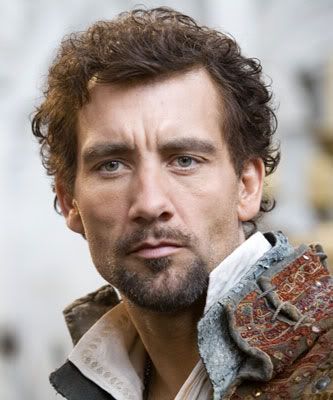
English aristocrat, writer, poet, soldier, courtier, spy and explorer known for popularizing tobacco in England (of all the things...) Played by Clive Owen in Elizabeth: The Golden Age (the guy Queen Elizabeth/Cate Blanchett kinda had the hots for and got all pissy when her maid married him).


Best remember him for his poetic response to Christoper Marlowe's "The Passionate Shepherd to his Love," "The Nymph's Reply to the Shepherd."

"The Nymph's Reply to the Shepherd"
If all the world and love were young,
And truth in every shepherd's tongue,
These pretty pleasures might me move
To live with thee and be thy love.

Time drives the flocks from field to fold
When rivers rage and rocks grow cold,
And Philomel becometh dumb;
The rest complains of cares to come.

The flowers do fade, and wanton fields
To wayward winter reckoning yields;
A honey tongue, a heart of gall,
Is fancy's spring, but sorrow's fall.

The gowns, thy shoes, thy beds of roses,
Thy cap, thy kirtle, and thy posies
Soon break, soon wither, soon forgotten -
In folly ripe, in reason rotten.

Thy belt of straw and ivy buds,
Thy coral clasps and amber studs,
All these in me no means can move
To come to thee and be thy love.

But could youth last and love still breed,
Had joys no date nor age no need,
Then these delights my mind might move
To live with thee and  be thy love.


Other Raleigh poems to note:

"To His Son"
Three things there be that prosper up apace
And flourish, whilst they grow asunder far;
But on a day, they meet all in one place
And when they meet they one another mar:
And they be these: the wood, the weed, the wag.
The wood is that which makes the gallow tree;
The weed is that which strings the hangman's bag;
The wag, my pretty knave, betokeneth thee.
Mark well, dear boy, whilst these assemble not,
Green springs the tree, hemp grows, the wag is wild,
But when they meet, it makes the timber rot;
It frets the halter, and it chokes the child.
Then bless thee, and beware, and let us pray
We part not with thee at this meeting day.

"The Author's Epitaph, Made By Himself."
Even such is time, which takes in trust
Our youth, our joys, and all we have,
And pays us but with age and dust,
Who in the dark and silent grave
When we have wandered all our ways
Shuts up the story of our days,
And from which earth, and grave, and dust
The Lord shall raise me up, I trust.

Henry Howard, Earl of Surrey (1517-1547)

Along with Thomas Wyatt, was the first to introduce Petrachan sonnet form into English.


"Description of Spring, Wherein Everything Renews, Save Only the Lover"
The soote season, that bud and bloom forth brings,
With green hath clad the hill, and eke the vale.
The nightingale with feathers new she sings;
The turtle to her make hath told her tale.
Summer is come, for every spray now springs,
The hart hat hung his old head on the pale;
The buck in brake his winter coat he slings;
The fishes flete with new repaired scale;
The adder all her slough away she slings;
The swift swallow pursueth the flies smale;
The busy bee her honey now she mings;
Winter is worn that was the flowers' bale.
And thus I see among these pleasant things
Each care decays, and yet my sorrow springs!

Monday, August 16, 2010

Sir Thomas Wyatt (1503-1542)

Along with the Earl of Surrey, was the first to introduce the Petrarchan sonnet form into English.

"Whoso List to Hunt"
Whoso list to hunt, I know where is an hind
But as for me, helas, I may no more.
The vain travail hath wearied me so sore,
I am of them that farthest cometh behind.
Yet may I by no means my wearied mind
Draw from the deer, but as she fleeth afore
Fainting I follow. I leave off therefore,
Sithens in a net I seek to hold the wind.
Who list her hunt, I put him out of doubt,
As well as I may spend his time in vain.
And graven with diamonds in letters plain
There is written, her fair neck round about:
Noli me tangere, for Caesar's I am,
And wild to hold, though I seem tame.

Whoso list = whoever wishes
hind = female deer
Noli me tangere = touch me not

The Renaissance (16th century)

And...we move into the Renaissance.
  • By 1600 English had become a powerful and expressive medium used by Shakespeare, Marlowe and translators of the Bible
  • The development of English is linked to the consolidation of the English state
  • The Renaissance emerged in England through an intellectual orientation to humanism (think Thomas More and his Utopia) 
  • Henry VIII's insistence on divorcing his first wife, Catherine of Aragon, led to the Protestant Reformation
  • Queen Elizabeth ruled during the late 1500s; she was featured as Gloriana, the eternally youthful Faerie Queene in Spenser's poem
  • Marlowe pioneered the blank verse, which was a significant change for English drama


Literary Forms developed during the Renaissance

The Middle Ages

I just realized I forgot to give kinda a literary/historical overview of each the Middle Ages, so here it is...I promise I will put one in for each literary period we go through from now on before we begin covering it!

These notes are drawn from the Norton anthology website and Wikipedia and whatever Internet page I pull up:

The Middle Ages


  • Time span - from collapse of Roman empire to the Renaissance (roughly 5th century to 15th century)
  • In literary terms, can be divided into 
    1. Anglo-Saxon period (c. 450-1066) 
    2. Anglo-Norman period (1066- c.1200)
    3. Middle English (13th and 14th centuries)
  • French words entered English vocabulary through Norman conquest in 1066
  • English replaced French as language of government in late 14th century
  • Chaucer's emulation of French and Italian poetry in English enhanced prestige of English language
  • Roman Catholic Church played large role in society


Common Features of Literature from the Middle Ages 

Litotes

Figure of speech containing an understatement for emphasis; opposite of a hyperbole. Created through use of a double negative. Common in Old English literature, e.g. Beowulf.

Example:

Spake then his Vaunt the valiant man,
Beowulf Geat, ere the bed he sought: --
"Of force in fight no feebler I count me,
in grim war-deeds, than Grendel deems him."

Beowulf means that he's stronger than Grendel.

Or a common everyday example: "not bad" meaning "very good".

Sunday, August 15, 2010

Beast Epic/Fable

Allegorical tale, in which animals are characters and style is pseudo-epic.

Example: The Nun's Priest's Tale (The Canterbury Tales)

Mock-Heroic

The mock-heroic is a style in which a heroic manner is adopted to make a trivial subject seem grand in such a way as to satirize the style. Commonly used in burlesque and parody.

Example: The Nun's Priest's Tale (The Canterbury Tales)

Bob and Wheel

Metrical device found in alliterative verse. The first short line of a group of rhyming lines is known as the 'bob', and the following four as the 'wheel'. The "bob" is a one foot line and the "wheel" is a quatrain of trimeter lines. The "bob and wheel" rhyme ababa. 


The boar makes for the man with a mighty bound
So that he and his hunter came headlong together
Where the water ran wildest - the worse for the beast,
For the man, when they first met, marked him with care,
Sights well the slot, slips in the blade,
Shove it home to the hilt, and the heart shattered,
And he falls in his fury and floats down the water,
                                         ill-sped.
          Hounds hasten by the score
          To maul him, hide and head;
          Men drag him in to shore
          And dogs pronounce him dead.

Rhyme Royal

A stanza form of seven decasyllabic lines rhyming ababbcc.

Because Chaucer was the first to use it, it is also known as the Chaucerian stanza. 


Examples:

The Prioress's Tale (The Canterbury Tales)
Troilus and Criseyde

Medieval Plays

Three types of medieval plays you gotta know:

1. Mystery Play
  • one of the earlies formally developed plays in medieval Europe
  • representation of Bible stories - tableaux with antiphonal song
  • eventually became secular and performed in the vernacular
  • taken over by guilds (mysterium, hence mystery play)
  • based on Bible - particularly concerned with stories of man's Creation, Fall and Redemption

2. Miracle Play
  • later development of mystery play
  • dramatized saints' lives and divine miracles, as well as legends of miraculous interventions by the Virgin  

3. Morality Play
  • allegory in dramatic form
  • origins in mystery and miracle plays
  • dramatization of battle between good and evil in human soul (i.e. exteriorization of inward spiritual struggle)
  • example - Everyman

Caesura

A break or pause in a line of poetry, dictated by the natural rhythm of the language and/or enforced by punctuation.

Common in Old English verse.

Example: Beowulf

Julian of Norwich (c. 1342-1416)

  • one of greatest English mystics
  • had series of intense visions
  • wrote Sixteen Revelations of Divine Love - believed to be first book written by a woman in English

Margery Kempe (c. 1373-1438)

  • Wrote The Book of Margery Kempe, first autobiography in English
  • strove to live life committed to God
  • negotaiated chaste marriage with husband
  • made holy pilgrimages, stories of which comprised much of her book
  • significant for insight to middle class life in the Middle Ages

Robert Henryson (1425-1500)

Facts:
  • Wrote a conclusion to Chaucer's Troilus and Criseyde
  • Longest work - "Morall Fabillis of Esope" - collection of 13 fables
  • In his The Testament of Cressied, he supplements Chaucer's tale of Troilus with Cressied's story. 

Sir Thomas Malory (1405-1471)

Things to know:
  • Wrote Le Morte D'Arthur in Late Middle English.
  • Obtained material from French sources
  • Essentially a bunch of stories about King Arthur's court
Distinguishable from Sir Gawain and the Green Knight because it is in prose form (Sir Gawain is in verse). 

John Gower (c. 1330-1408)

Unlikely to appear on exam, but know that he is a contemporary of Chaucer's, and that Chaucer referred to him in Troilus and Criseyde.

Most famous work - Confessio Amantis. Written in English, collection of tales of courtly love. One of the stories served as a source for Shakespeare's Pericles, in which Gower appears as a character in the Chorus.

Geoffrey Chaucer (c. 1343-1400)

The Canterbury Tales is an ETS favorite. Lucky I took that Chaucer class...


Chaucer (c. 1343-1400) writes in Middle English. It's not that difficult to translate, but it's always a good idea to read a bit of it to get a feel around it. No need to read the entire Canterbury tales (unless you took a class on it); but there are several tales you should know. The framework of the story is Chaucer the narrator goes on a pilgrimage with a bunch of other people and they each take turns telling a story because the prize for best story is a free dinner.


The Knight's Tale


Do NOT watch the movie with Heath Ledger and think it's the same thing.


Characters: Cousins Arcite and Palamon, Theseus (king of Athens who also conquers Thebes), Hippolyta (wife of Theseus), Emelye (sister of Hippolyta)
Arcite and Palamon are cousins from Thebes who are Theseus' prisoners-of-war. While locked up in a tower in Athens, they both fall in love with Emelye, the queen's sister. They both manage to escape and organize this battle to see who should win Emelye. Arcite prays to Mars for help and Palamon prays to Venus (Emelye prays to Diane to preserve her virginity, go figure). Arcite wins the battle but an earthquake by Saturn startles Arcite's horse and he falls to the ground, mortally wounded. Palamon and Emelye grieve for like ever until Theseus says quit it and they both get married and live happily ever after.


The Miller's Tale
Characters: Nicholas (student), Alisoun (carpenter's wife), John (carpenter), Absalom (suitor)
Nicholas has the hots for Alisoun and they tell the carpenter John that he should spend the night on the roof sleeping in a tub because a flood like Noah's flood is coming. While Nicholas and Alison are getting it on, Absalom, another of Alisoun's suitors, comes around and Alisoun shoves him her butt to kiss. Absalom is pissed and fetches a hot poker. The second time around, Nicholas sticks his butt out, but Absalom sticks the hot poker into Nicholas' butt. Nicholas screams "Water! Water!" and the carpenter, thinking it's the flood, cuts himself and his tub down from the roof. He falls to the ground and everyone thinks he's mad.


The Prioress's Tale
Told in rhyme royal.
A little boy singing a hymn is murdered while walking through a Jewish neighborhood. His throat is slit and he's thrown into a poop ditch. His mother looks high and low for him and finds him only because he's still singing even though his throat is slit. The boy reveals that the Virgin Mary placed a seed in his mouth which enables him to sing even though obviously he shouldn't be able to. The Jews are hung and the boy goes to Heaven.


Nasty stuff.


The Nun's Priest's Tale
Characters: Chaunticleer (rooster), Pertelote (Chaunticleer's favorite hen), Sir Russell (fox)
Chaunticleer dreams he'll be eaten by a fox. Pertelote tells him he's crazy. The fox comes along and tricks Chaunticleer into singing with his eyes closed. The fox then snatches him away, but before he can gobble him up, the fox opens his mouth with the intention of gloating about how clever he was. Chaunticleer quickly flaps away and doesn't fall for the fox's tricks again.


The tale is a beast fable written in the mock-heroic style. 


The Merchant's Tale
Characters: January (old knight), May (January's young wife), Damian (May's suitor)
January marries May but goes literally blind and crazy with jealousy. He tries to keep May close to him like, all the time. May and Damian plan to meet in January's garden, and while she's doing it with Damian in a tree the god Pluto suddenly restores January's sight. May manages to convince January that she committed adultery in order to cure him.


The Pardoner's Tale
Three drunkards are told to look for Death under a particular tree, but instead they find some treasure there. They murder each other over who should get the treasure.


The Wife of Bath's Tale
One of King Arthur's knights rapes a maiden, but he escapes the death sentence because the queen puts him on a mission to find out what is it that women most want. The knight finds this ugly hag who will tell him the answer on the condition that the knight marry her. The knight agrees and gets the answer - sovereignty. The hag turns into a beautiful maiden once the knight marries her.


The Franklin's Tale
Characters - Aurelius, Dorigen, Arveragus. Arveragus and Dorigen are married happily, but Arveragus leaves on a trip somewhere, leaving Dorigen sad and alone. Aurelius, a young squire in love with Dorigen, meets her and confesses his love, but Dorigen says she'll only return it if Aurelius manages to remove all the rocks from the coast. Aurelius looks for a magician who does it for him, for the price of Aurelius' entire fortune. Dorigen is so shocked and she confesses everything to Arveragus. Arveragus says Dorigen must honor her word, so she goes to Aurelius, but Aurelius' conscience plays on him, and he lets Dorigen go. He returns to the magician to give him his fortune, but the magician doesn't take it because it didn't work out for Aurelius anyway. The tale ends with the Franklin asking, "Which was the mooste fre, as thynketh yow?" (who was the most generous?)


The Reeve's Tale
Simkin (greedy miller), has his wife and daughter enjoyed by a pair of clerks (John and Alan) whom he swindled. Response to miller's tale of a foolish carpenter - the reeve was once a carpenter.


The Clerk's Tale
Griselda - patient woman who endures the trials of her husband, the Marquis Walter.


The Physician's Tale
A knight, Virginius, kills his daughter Virginia to avoid having her fall into the hands of an evil judge, Apius who covets her.


Troilus and Criseyde
  • Another of Chaucer's works. 
  • Written in  rhyme royal
  • Shakespeare also composed a version of Troilus. 
  • Story taken from Boccaccio's Il Filostrato. 
  • Influences from Dante - final prayer translated from Dante's Divine Comedy. Set in Troy during the Trojan war.                            
Characters: Troilus, Criseyde, Pandare, Diomede
Troilus and Criseyde are brought together by Troilus' friend, Pandare. Criseyde leaves Troy to join the Greeks. Troilus finds out Criseyde has been unfaithful to him because he sees her brooch on Diomede's cloak - Diomede is a Greek warrior. He wants but fails to kill Diomede. 


The poem begins:


The double sorwe of Troilus to tellen,
That was the king Priamus sone of Troye,
In lovinge, how his aventures fellen
Fro woe to wele, and after out of joie,
My purpos is, er that I parte fro ye
Thesiphone, thou help me for t'endite
These woful vers, that wepen as I write.
To thee clepe I, thou goddess of torment,
Thou cruel Furie, sorwing ever in peyne,
Help me, that am the sorwful instrument,
That helpeth loveres, as I can, to pleyne.
For wel sit it, the sothe for the seyne,
A woful wight to han a drery feere,
And to a sorwful tale, a sory chere.


Thesiphone is the guardian of the gates to the Underworld.


The poem ends:
Go, little book, go, little myn tragedye,

Ther God thy makere yet, er that he dye,
So sende might to make in some comedye!
But little book, no making thou n'envie,But subgit be to alle poesye;
And kiss the steppes, wheras thou seest paceVirgile, Ovide, Omer, Lucan, Stace... 


It ends with an invitation to John Gower to correct the work if necessary.